
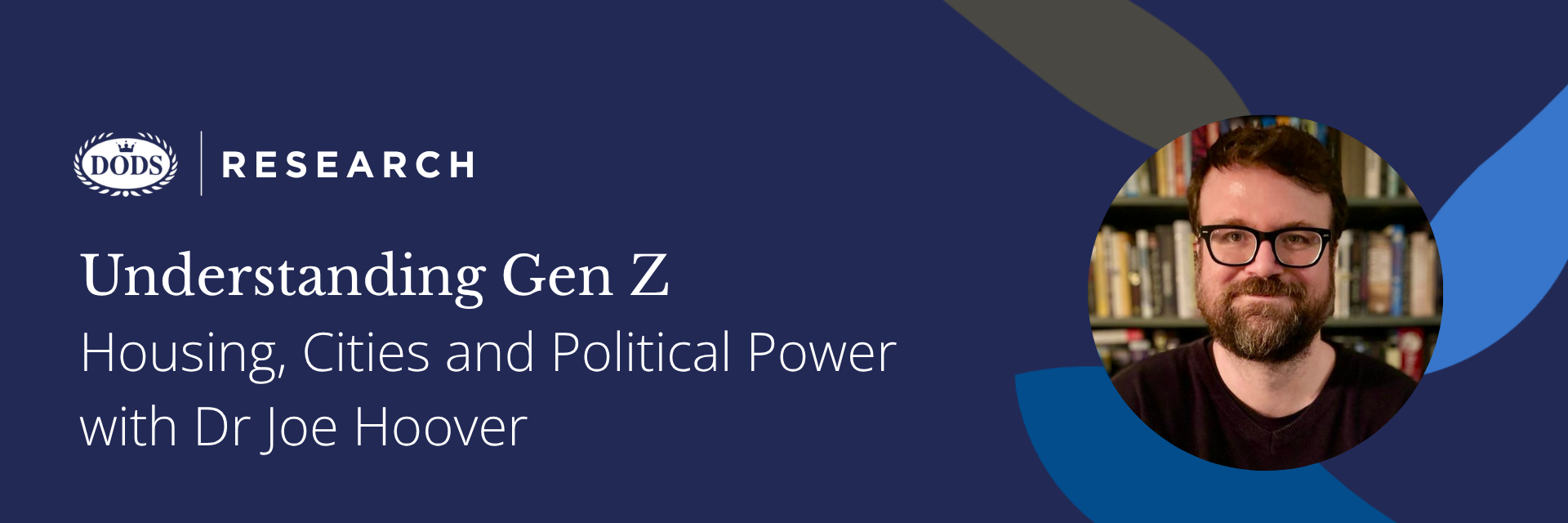
To kick off our new Gen Z blog series, part of our ongoing research collaboration with Queen Mary University of London, Dr Joshua Wells speaks to Dr Joseph Hoover about the challenges facing young people today — from the housing crisis and life in cities to political representation, democratic participation and what meaningful change could look like.
Dr Joshua Wells:
Thank you for joining me today, Joe. This interview is part of our Gen Z series, where we’re exploring issues affecting Gen Z, possible policy solutions, and how to better understand what’s going on with them.
One of your focuses is on the urban. Could you start by explaining what’s interesting about cities?
Dr Joe Hoover:
There’s a big-picture reason why I think the urban is interesting. Somewhere around 2007, humanity went from being majority rural to majority urban, and that trend has continued. Something like 60% of the world’s population now lives in cities.
So I became interested in cities because they’re a kind of common condition for humanity. If we attend to what’s distinctive about cities, we can maybe get a better grasp on some of the political issues we face.
There was also a real sense in the 2010s that cities were important spaces for economic development, innovation and public policy, and that city governments could sometimes be more agile than national governments.
Benjamin Barber famously argued that nation-states were failing to address global problems and that cities could be part of the solution. But it struck me that there was a tendency to focus on the economic and to treat politics as a relatively technocratic endeavour.
What I was seeing in work on human rights, housing and urban justice was a reality where cities contained a lot of injustice and governing institutions weren’t always functioning particularly well for people. But there were also vibrant urban justice movements and democratic cultures.
So that nexus of problems and possibilities is a really fertile way to get a sense of our political moment.
Dr Joshua Wells:
Focusing specifically on Gen Z, are there particular problems or possibilities that are distinctive to their experience of cities?
Dr Joe Hoover:
Yeah. At the macro level, the problems are kind of human problems, but I think there are things that are really distinctive for young people.
One that jumps to mind is housing. Young people face, especially in the UK, absolutely astronomical housing costs, certainly for buying but even for renting.
You see the burden in the amount of income that has to be devoted to housing. We see students working multiple jobs trying to pay rent, or commuting for hours because they’re still living with their parents.
Every generation has struggled with finding a home, and I’m sure every generation has thought housing was too expensive. But I do think this generation has a particular burden.
This is where looking at cities is helpful. Cities have long been spaces for the reinvestment of surplus capital. Particularly into the 21st century, one of the ways cities absorbed surplus capital circulating in an increasingly unequal global economy was through housing.
That means demand isn’t necessarily being driven by local need. London is a great example. You get developments that aren’t designed with local communities, young people or their budgets in mind.
They’re also often located in gentrifying areas, where devalued urban spaces are redeveloped and new housing is built. Local young people don’t necessarily benefit from that.
So housing in cities becomes wrapped up in the global economy, and young people can be excluded from or exploited by the housing market.
When young people leave university or school and go into work, there’s real exclusion from buying, but also problems with renting: high prices and weaker tenancies.
Young people are pushed around. You might move to a city for the opportunities, but then bounce between neighbourhoods or ultimately leave.
So finding a place to live when you’re young is always a challenge, but I think this generation faces something distinctive.
Dr Joshua Wells:
You’re a political theorist, and political theory is often associated with conceptual clarity. Is this simply a case of intergenerational injustice, or is something else going on?
Dr Joe Hoover:
Yeah, I think the generational justice element is useful to a degree.
Particularly in the UK and London, with housing prices taking off in the 80s and 90s, and the sell-off of social housing under Thatcher’s Right to Buy, there is a real dynamic where a certain generation got into the property market at a totally different level of expense and has been able to benefit from that.
But I think that can place too much emphasis on individual responsibility.
Underneath that, there are really important shifts in the way housing is understood.
The UK, like much of Europe, had in the post-war period a sense that housing was something socially provided. There was a sense that housing wouldn’t simply be distributed according to how much someone could pay.
It was a basic human need, but it also had a vital social function. You couldn’t have healthy, functional communities if people couldn’t live where they worked, where they had grown up, or where they had connections and family.
But with the neoliberal revolution of the 70s into the 80s, there’s a move to treat housing as a commodity.
With Right to Buy, that becomes wrapped up in an individualised ethos. But 20 or 30 years down the line, you have massive conglomerations of banks investing in urban developments.
We are treating housing not as a human need, not as something essential to community, but simply as one more thing that you can swap and trade.
A good example was the E15 Mothers in Newham, young mothers who had been forced out of council housing and were facing relocation. One of the striking responses by policymakers at the time was essentially: if you can’t afford to live in Newham, you can’t live in Newham.
That was such a bald expression of the logic. If you can’t afford an iPhone, you don’t get an iPhone. If you can’t afford a house, you don’t get a house.
So if we focus only on older Londoners who benefited from rising property prices, I think we miss the much bigger political economy story about how the nature of housing itself has changed.
Dr Joshua Wells:
Does that understanding help us identify what solutions might look like?
Dr Joe Hoover:
Yeah, I think it’s still an underlying story rather than necessarily saying, do X, Y or Z.
But one thing that has really come through in work with housing activist and urban justice groups is that, at the core of resistance to gentrification and the commodification of housing, is the idea that we should have some control over where we live.
And beyond where we live, we should have some control over the local area.
There was an earlier conception where housing was often seen as a kind of service, and that was problematic in its own way. In London, planners sometimes came into communities, knocked down existing housing and replaced it with large council estates, without really acknowledging the need people had for control.
The market gives a certain kind of control to a certain kind of individual. But for most people, and for communities, it can be experienced as a lack of control.
So the question becomes: how do we allow people to have some sort of control over their housing?
Does that mean a return to council housing like the 1950s? Probably not. The capacity of government to do that doesn’t exist in quite the same way, and there were problems with that model as well.
So looking at control opens up a different set of questions. Is control of housing something that can only be done through government? Is it done nationally, locally? What’s the role for communities?
One model I’ve been interested in is community land trusts. The basic idea is that land is placed in a trust rooted in the community, which then retains control over it and can work with developers to provide housing.
These models run into all manner of difficulties, but the underlying idea is useful.
If I had the chance to bend a policymaker’s ear, it would be: what are the ways we can return meaningful control over housing to communities and people, so that something essential to human life isn’t simply distributed according to where the greatest profit can be made?
So for me, the fundamental question is control.
Dr Joshua Wells:
Do political institutions currently work for Gen Z and young people? And is there anything we could hope for from those institutions that might allow them to work better?
Dr Joe Hoover:
Yeah. If we’re thinking about democratic institutions in the UK, across Europe and North America, they definitely seem to be in some kind of trouble.
One thing that seems apparent is that governing institutions are not particularly responsive to the needs of citizens and constituents, and I think that’s even more pronounced for young people.
You see in students, and more broadly in the political attitudes of young people, a real disillusionment and cynicism which seems to me totally justified based on experience.
If forms of representative government have become less representative and less responsive, they’re going to be even less responsive to those who are, from a politician’s point of view, more marginal.
Young people don’t have many powerful partners in contemporary governance.
The state of universities is one example. Students are paying more for tuition, the student loan deal keeps getting worse, and the funding model is also bad for universities.
Part of the issue is that young people, whether it’s university or training schemes, don’t have much leverage on government. They don’t have the government’s attention.
But there are signs of hope.
I’ve just finished a book on cities, and it was more hopeful than I thought it was going to be when I started writing it.
Dr Joshua Wells:
Did you become more hopeful whilst writing it?
Dr Joe Hoover:
Yeah, I think maybe I did.
Part of that has to do with the way cities are real political spaces.
For most people, national politics doesn’t exist anywhere they can see. Whereas, with the local, people can see the political world around them.
I was looking at a survey suggesting that trust in government is down globally, but is highest with local governments.
The explanation seems to be that people can see either that a problem is being addressed or, if it isn’t addressed in the way they want, they can at least see some response. There’s some deliberation, some back and forth, some democratic meat on the bones still.
I’m more hopeful, though, because cities are spaces where people can organise democratically.
People can come together because you’re literally working with people who are next to you or experiencing the same problem. And that is a kind of power.
There’s also a big challenge: how do you scale from the neighbourhood or city level to national or global politics?
Local community groups may be organising against developments backed by international banks. Building community power takes years and huge amounts of time. Against a corporate entity with a global footprint, it’s still a David and Goliath fight.
But I think there’s a danger in saying that only complete systemic transformation will make a difference. The question then becomes: okay, but what do we do in these times?
Where communities can make progress in changing neighbourhood or city governance, you can start to get the power of a city behind you.
Where I come down between the optimistic and negative stories is that I think it’s the work of decades and generations.
And so, to go back to Gen Z, that’s kind of the challenge before them. Particularly for young people living in cities: are you going to be part of your city? Can you sustain the kind of political activity involved in making those changes?
It’s a huge opportunity, but it’s a huge challenge.
Dr Joshua Wells:
Finally, what are the benefits of engaging with political theory to understand challenges and possible solutions such as these?
Dr Joe Hoover:
Yeah, I’ll try not to make the response too academic and navel-gazing.
My approach to political theory is a little bit different from a conventional model, where someone like Rawls would be the godfather figure.
There’s a tendency to figure out the ideal first and then apply it to the problems of the world. I think that can be problematic because it tends to limit our understanding.
Part of my work on gentrification was asking: is gentrification unjust?
Political theorists had started to identify particular aspects of gentrification as unjust. But it always felt too narrow to me, given the experience I’d had in spaces where people were actually fighting gentrification.
Rather than thinking of the philosopher’s job as identifying what we should do in general, I tend to think of it as: how do we use these tools to understand and clarify the complex reality we see?
And then, really in collaboration with others, how would we improve that?
Political theory is also a kind of work of translation.
If you’re hearing from residents who are facing eviction, they want to stay in their neighbourhood. They’ve got family there, livelihoods there. It means something to them.
So I think of my job as a political theorist as asking: how does that insight travel?
What can we pull out of engaging with a community group? And then, in a discussion with a policymaker, what are some of the directions we could push things that might solve these problems and bring different constituencies together?
It’s a little bit of a dissident approach to political theory, but lots of political theorists have turned their attention to the world, trying to do things with people and trying to be a bit more practical.
Dods Political Intelligence’s ongoing research collaboration with Queen Mary University of London brings together academic expertise and political intelligence to provide public affairs professionals with tailored expert insights and analysis on UK politics and policy. We are actively exploring a research project to better understand the nature of the challenges that Gen Z face, and how these challenges can be measured via a typology of hardship.
If you wish to know more about this project, or are interested in how we can develop a tailored research project to support your public affairs objectives, please contact us here.